


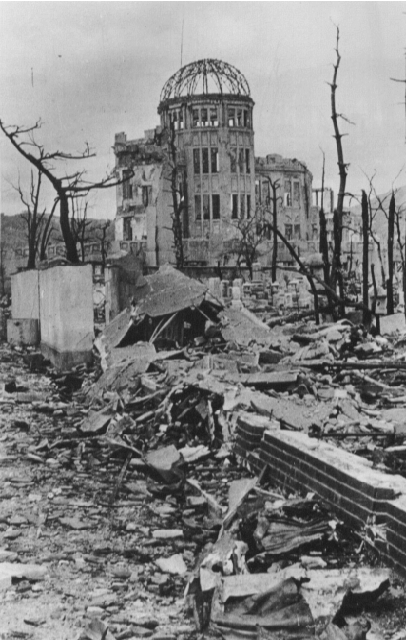
As we commemorate the anniversaries of the atomic bombings of Hiroshima and Nagasaki on 6 and 9 August respectively in 1945, the ITUC-Asia Pacific honours the memory of all those who lost their lives and pays tribute to the survivors, whose courage and testimony have sustained humanity’s resolve that such a tragedy is never be repeated.
Eighty-one years after the dawn of the nuclear age, the world continues to live under the shadow of nuclear weapons. Instead of moving towards nuclear disarmament, we are witnessing growing geopolitical tensions that fuel renewed arms races and the dangerous illusion that peace can be maintained through nuclear deterrence. At the same time, emerging technologies, including artificial intelligence (AI), in military surveillance and nuclear weapons systems are creating new risks of unintended escalation and catastrophic miscalculation.
The people of Asia and the Pacific know too well the devastating consequences of war. Across our region, workers continue to bear the costs of conflict, militarisation, and instability. Resources that could have been invested in decent jobs, quality public services, social protection, healthcare, education, and climate action are instead diverted towards ever-increasing military expenditure.
Peace is not merely the absence of war. It is the foundation upon which democracy, social justice, and decent work are built. Without peace, workers cannot exercise their rights, organise freely, bargain collectively, participate fully in democratic life, and live with dignity. There can be no lasting prosperity where fear, insecurity, and violence prevail.
Trade unions therefore have a responsibility not only to defend wages and working conditions, but also to speak out for peace and human security. Working people do not benefit from nuclear weapons. They benefit from hospitals, schools, social protection systems, sustainable industries, and societies founded on democracy and respect for human rights.
The ITUC-Asia Pacific recognises and salutes the lifelong efforts of the hibakusha,1 whose testimonies have served as a moral conscience for humanity. Their message remains as urgent today as ever: humanity and nuclear weapons cannot coexist.
We call on all governments to recommit themselves to genuine nuclear disarmament and to take concrete steps towards the complete elimination of nuclear weapons. We urge all countries in Asia and the Pacific to engage constructively with the Treaty on the Prohibition of Nuclear Weapons and to strengthen international cooperation to reduce tensions, prevent conflict, and advance lasting peace.
At a time when democracy is under pressure and the world faces multiple crises, workers and their unions must continue to stand together across borders in defence of peace, democracy, and human rights. International solidarity, social dialogue, and multilateral cooperation are indispensable to building a peaceful, sustainable, and just future.
As we remember Hiroshima and Nagasaki, we renew our commitment to a world where resources are invested in people, not in weapons of mass destruction; in hope, not in fear; in solidarity, not in division.
There can be no decent work without peace. And there can be no lasting peace while nuclear weapons continue to threaten humanity.
Never again.
1 Hibakusha are the survivors of the atomic bombing in Hiroshima and Nagasaki on6 and 9 August 1945, respectively.

%201.svg)
%201.svg)


%201.svg)


