


On the International Day for the Total Elimination of Nuclear Weapons, ITUC-Asia Pacific joins trade unions and peace advocates worldwide in issuing a renewed call to eliminate nuclear weapons once and for all.
The horrors of Hiroshima and Nagasaki 80 years ago remain a stark reminder of the catastrophic consequences of nuclear arms. Eight decades later, the current global nuclear landscape gives little reason for optimism and indicates that the lessons of history remain unheeded. As of 2025, nine states possess nuclear arsenals exceeding 12,000 warheads, with the vast majority held by the United States and Russia, whose escalating geopolitical tension further destabilises international security.
Despite decades of appeals for disarmament, these stockpiles remain at alarming levels. Compounding this danger is the risk of a cascading chain reaction, in which the possession of nuclear weapons by some states drives others to follow. The ongoing modernisation of arsenals, including the incorporation of emerging technologies such as artificial intelligence, fuels an increasingly perilous arms race.
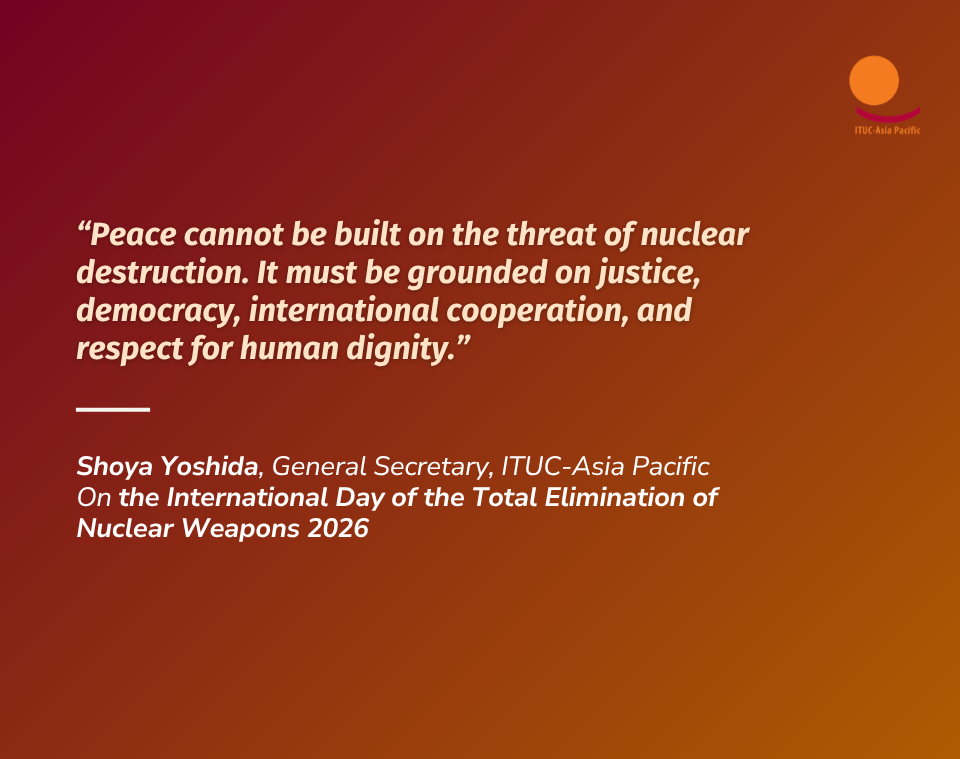
“We said then, and we say again today: the belief that nuclear deterrence prevents major wars is a deadly myth,” said Shoya Yoshida, General Secretary of ITUC-Asia Pacific. “Far from guaranteeing peace, nuclear deterrence puts humanity under the constant threat of annihilation.”
ITUC-Asia Pacific draws attention to the surging global military spending, which drains resources away from pressing human needs such as tackling climate change, addressing poverty and inequality, and upholding human dignity.
“Instead of squandering billions on weapons of mass destruction, governments must invest in decent work, social protection, and quality public services,” Shoya Yoshida added.
ITUC-Asia Pacific urges nuclear-armed states to take genuine steps toward disarmament, and for all governments to recommit to non-proliferation. It asserts that the continued failure of nuclear-armed states to meet their disarmament obligations has gravely undermined the credibility of the Nuclear Non-Proliferation Treaty (NPT) and deepened frustration among non-nuclear states. Against this backdrop, the Treaty on the Prohibition of Nuclear Weapons (TPNW) emerges as a vital legal instrument to advance global disarmament and strengthen the international order.
“The TPNW is humanity’s best chance to end the nuclear threat,” said Shoya Yoshida, General Secretary of ITUC-Asia Pacific. “Every day of delay keeps the world at risk. Governments must ratify the treaty now and take responsibility to build a nuclear-free world and lay the foundation for just and lasting peace. Meanwhile, trade unions will continue to mobilise workers, build alliances across movements, and hold governments accountable to ensure disarmament becomes a reality.”

%20(1).jpg)

.jpg)
















.jpg)








.png)


.png)


%20(1).png)


.jpg)


.png)


%201.svg)


