


The International Trade Union Confederation-Asia Pacific (ITUC-Asia Pacific), representing millions of workers across the region, expresses its serious concern over the ongoing negotiations of the ASEAN Digital Economy Framework Agreement (DEFA), which continue to proceed with limited transparency and without the meaningful participation of trade unions and affected stakeholders.
As digitalisation and platform work rapidly reshape labour relations and broader economic and power structures, it is clear that the rules governing the digital economy will determine whether workers benefit from this transformation or are further marginalised. ITUC-Asia Pacific underscores the urgency of ensuring that global and regional rules on digitalisation uphold, rather than undermine, labour standards.
The digital economy today is marked by deep structural tensions: between flexibility and security, value creation and value capture, and technological control and democratic regulation. ITUC-Asia Pacific warns that the current trends in platform work are intensifying informalisation, weakening job security, obscuring employer responsibility, and concentrating economic gains in the hands of a few. It is also gravely concerned about the continued misclassification of platform workers as independent contractors, which denies them access to labor rights, social protection, and collective bargaining.
Platform work and digitalisation often reinforce existing inequalities, including gender-based, migrant, and informal work vulnerabilities, which must be explicitly addressed in policy responses.
Workers across the region have shared lived realities of falling pay rates, arbitrary job allocation, and what can only be described as “precarity by design,” where platforms exert significant control over workers through algorithmic management while evading accountability. These platforms are no longer neutral intermediaries or marketplaces; they are powerful actors shaping labour conditions, market access, and economic outcomes for both workers and businesses.
Trade unions have identified urgent priorities: guaranteeing workers’ rights – including platform workers’ rights to organise and bargain collectively regardless of their employment status, ensuring transparency and accountability of platforms, and expanding universal and adequate social protection. However, ITUC-Asia Pacific cautions that digital trade agreements such as DEFA could lock in rules that undermine these priorities, both by restricting governments’ ability to regulate, enforce labour standards, and hold corporations accountable and by creating a “regulatory chill” effect, where governments may hesitate, delay action, or avoid introducing stronger protections for platform workers.
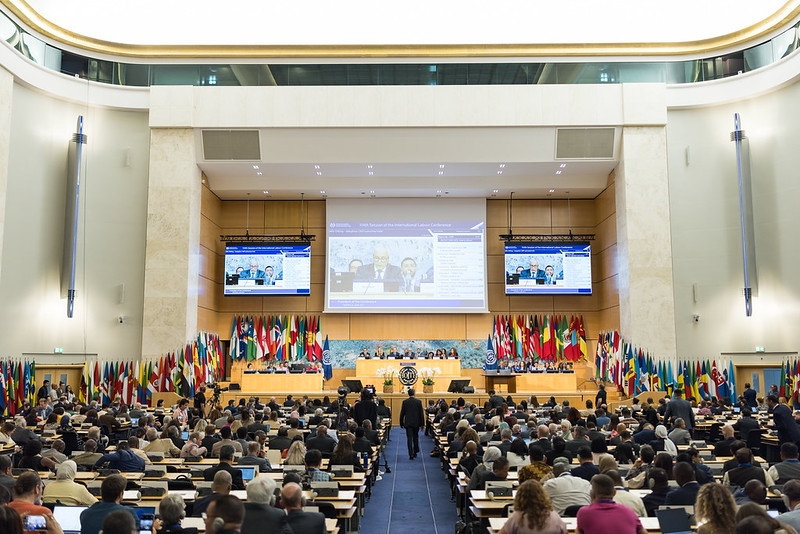
Recent developments in the International Labour Organization (ILO), including those reflected in the “Blue Report,”1 highlight the importance of vigilance to ensure that parallel trade negotiations do not undermine emerging global labour standards, including the ongoing efforts to establish binding standards on platform work.
ITUC-Asia Pacific asserts that digital governance is not merely a trade issue. It is fundamentally a matter of rights, democratic accountability, and development.
In this context, ITUC-Asia Pacific:
The digital economy is being built today, and the rules governing it will shape the future of work. Trade agreements such as DEFA must not entrench inequality, weaken labour protections, or deepen corporate control. Instead, the governance of the digital economy, including the regulation of platform work, must be aligned to ensure that workers’ rights are not traded away in the name of economic integration.
ITUC-Asia Pacific stands united in demanding a digital future grounded in workers’ rights, democratic governance, and social justice — not secrecy, deregulation, and corporate power.
1 The ILO Blue Report on decent work in the platform economy is the final consolidated report for negotiation at the 114th Session of the International Labour Conference (ILC). It compiles the responses of governments, workers and employers to the Brown Report and incorporates outcomes from earlier stages of consultation and negotiation. On this basis, it presents a revised draft Convention and Recommendation in structured legal articles, serving as the basis for line-by-line discussion and further negotiation at the ILC.

%20(1).jpg)
.jpg)
















.jpg)



.png)




.png)


.png)


%20(1).png)


.jpg)


.png)


%201.svg)


